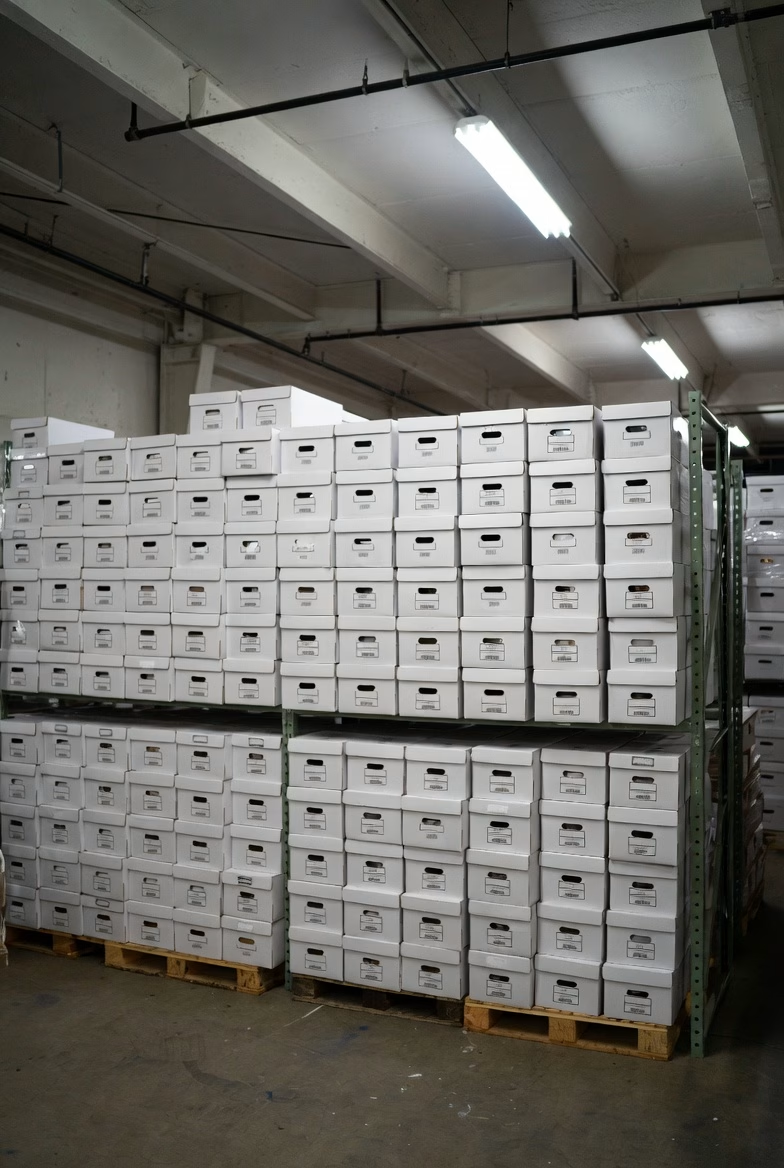
If you manage a homeowners association in Arizona, your filing cabinets probably tell a story you would rather not think about — decades of meeting minutes, financial statements, architectural review files, violation letters, and governing documents stacked in boxes that nobody wants to organize but nobody dares throw away.
That instinct to hold on to everything is not entirely wrong. Arizona law imposes specific retention requirements on community associations, and some records must be kept permanently. The challenge is knowing which documents fall into which category and making sure they are actually accessible when a homeowner, auditor, or attorney comes looking.
What Arizona Law Requires
HOA records retention in Arizona is governed by two main statutes: ARS 33-1805 (for planned communities) and ARS 10-11601 (which applies to HOAs incorporated as nonprofit corporations, as most are).
Together, these statutes create three tiers of retention requirements.
Records You Must Keep Forever
Certain foundational documents must be retained permanently. These include the CC&Rs (declaration of covenants, conditions, and restrictions), articles of incorporation, bylaws, all amendments to governing documents, deeds, easements, and board resolutions relating to member rights and obligations.
Meeting minutes — both board and member meetings — are also considered permanent records under ARS 10-11601. There is no point at which it becomes safe to discard them.
Records You Must Keep for Seven Years
Financial records fall into this category. While ARS 10-11601 requires financial statements to be available for at least the past three years, the widely accepted best practice for community associations is seven years. This aligns with IRS audit timelines and ensures the association has a complete financial history for budgeting, reserve studies, and potential litigation.
Financial records include annual budgets, bank statements, tax returns, reserve fund reports, vendor invoices, assessment records, collection activity, and insurance policies.
Records You Must Keep for at Least Three Years
Written communications to members generally, notices of meetings, and records of actions taken without a meeting must be maintained for at least three years under ARS 10-11601.
Architectural review applications, violation notices, and routine correspondence typically fall into this category as well, though many associations choose to retain these longer for liability protection.
Homeowner Access Rights: The 10-Day Rule
An Arizona HOA has ten business days to let a member examine association records, and a separate ten business days to deliver copies a member asks to buy. Both deadlines come from A.R.S. § 33-1805(A) for planned communities; condominium associations follow a matching provision, A.R.S. § 33-1258(A).
What the statute actually requires:
- Who can ask: any member, or a person the member designates in writing as their representative.
- Review is free. The association cannot charge for making records available to examine.
- Copies are capped at fifteen cents per page.
- Two clocks, not one: ten business days to provide examination, and ten business days to provide purchased copies.
- What may be withheld: privileged attorney communications, records relating to pending litigation, minutes of board sessions not required to be open, personal, health or financial records of individual members or employees, and employee job-performance, compensation and complaint records, plus anything whose disclosure would violate state or federal law (§ 33-1805(B)–(C)).
This access requirement is one of the strongest reasons to keep records organized and retrievable. A board that cannot locate requested documents within the ten-day window risks legal complaints and loss of homeowner trust.
Why Paper Records Become a Liability
Most Arizona HOAs accumulate paper records over years or decades of operation. Over time, these records create several problems that go beyond simple clutter.
Retrieval delays. When a homeowner submits a records request, staff or board volunteers must physically search through files to locate the relevant documents. For associations with records spread across multiple boxes, storage units, or management company offices, meeting the ten-day deadline becomes a real challenge.
Transition risks. When an HOA changes management companies — a common occurrence — physical records must be transferred. Documents get lost, misfiled, or damaged during transitions. Some associations discover gaps in their records only when a dispute arises and the relevant paperwork cannot be found.
Disaster vulnerability. Arizona may not face hurricanes, but fire, flooding from burst pipes, and monsoon water damage are real threats to paper archives. Governing documents that must be kept permanently are irreplaceable if destroyed.
Storage costs. A mid-size HOA managing 200-500 homes can easily accumulate dozens of boxes of records over a ten-year period. Offsite storage rental, retrieval fees, and the staff time required to manage physical files add up quietly but consistently.
How Scanning Solves These Problems

Digitizing HOA records addresses every challenge above while making compliance with Arizona’s retention and access requirements significantly easier.
Instant retrieval. Scanned records stored as searchable PDFs can be located in seconds using keyword search. When a homeowner submits a records request, the response can be prepared in minutes rather than days.
Management transitions. Digital archives transfer seamlessly between management companies. There are no boxes to ship, no pages to inventory, and no risk of documents disappearing during the handoff.
Permanent preservation. Documents that Arizona law requires you to keep forever — CC&Rs, bylaws, meeting minutes — are protected from physical damage when stored digitally with proper backups. The digital copy will be as legible in fifty years as it is today.
Reduced costs. Scanning eliminates the ongoing expense of physical storage and dramatically reduces the staff time devoted to filing and retrieval. For associations paying monthly storage fees, the scanning project often pays for itself within a year.
Board and homeowner confidence. A well-organized digital archive signals professionalism. Board members can access any document from any location, and homeowner requests are handled quickly and completely.
Getting Started: What to Scan First
If your association is considering digitizing its records, the most practical approach is to prioritize by retention requirement.
Start with permanent records. CC&Rs, bylaws, articles of incorporation, all amendments, board resolutions, and meeting minutes. These are irreplaceable and carry the highest risk if lost.
Then financial records. Current and recent fiscal year documents first, working backward through the seven-year window. This ensures your most frequently requested records are available digitally as soon as possible.
Finally, correspondence and administrative files. Violation records, architectural applications, vendor contracts, and general communications. These have shorter retention requirements but are often the most frequently requested.
Arizona HOA Records Requests: Common Questions
Is it ten calendar days or ten business days?
Ten business days. Weekends and holidays do not count, but that is still only about two calendar weeks, which is short if the records sit in boxes off-site.
Does a homeowner’s records request have to be in writing?
The statute does not say the request itself must be written. The writing requirement in § 33-1805 applies to a member designating someone else as their representative. Many boards still ask for requests in writing so the date the clock started is documented.
Do the same rules apply to condominium associations?
Yes. A.R.S. § 33-1258 gives condominium unit owners the same ten-business-day examination and copy deadlines, the same free review, and the same fifteen-cent-per-page copy cap. It does not apply to timeshare-plan associations.
What if our records are at a former management company or in a storage unit?
The deadline still runs. Section 33-1805 places the duty on the association, not on whoever happens to hold the boxes, so records stranded with an outgoing manager or in off-site storage do not pause the clock. This is one of the most common ways boards miss the deadline, and the strongest practical argument for keeping a complete, searchable digital copy the board itself controls.
Can an HOA charge a homeowner to look at records?
No. Review must be free. The only fee the statute allows is for copies the member asks to purchase, capped at fifteen cents per page.
Overland Printing scans and indexes HOA and condominium records for associations anywhere in Arizona — Tucson, Flagstaff and Yuma included — with courier pickup for boxes outside the Phoenix metro. Call 602-224-9971.
This is a plain-language summary of A.R.S. §§ 33-1805 and 33-1258, not legal advice. Confirm specific situations with your association’s attorney.
Protect Your Community’s Records
Arizona’s HOA records requirements are not optional, and the consequences of poor recordkeeping — from homeowner complaints to legal exposure — are real. Scanning your association’s documents is one of the most cost-effective ways to stay compliant, organized, and prepared for whatever comes next.
Overland Printing has served Phoenix-area organizations for over 25 years. We handle high-volume document scanning with secure chain of custody, searchable PDF delivery, and organized indexing — so your board can find any document in seconds, not hours.
Ready to get your HOA records under control? Get a free scanning quote or call us at 602-224-9971.
This article is provided for general informational purposes and does not constitute legal advice. HOA boards should consult with a qualified community association attorney regarding their specific retention obligations.
Records disputes in Arizona communities often end in mediation or arbitration rather than a courtroom, and both still run on paper. When a homeowner claim or a board dispute reaches that stage, we produce the mediation and arbitration binders from the same digital archive we built for you.
Related Services
- Document scanning for HOAs and property managers — meeting-minute archives, financial records, CC&R amendments
- Legal scanning for HOA records-request response — Bates numbering and indexed delivery when a homeowner request has a deadline
- Arizona medical records retention requirements — the companion guide for healthcare practices, same statute-by-statute format
- Legal scanning for Phoenix law firms — case files, exhibits, and closed-matter archives
Need to digitize your community’s records? If your association or management firm is staring at decades of board minutes, ARC files, financials, or CC&R amendments, see our HOA records scanning service for community association management firms — locked transport, AZ-retention-aware indexing, DMS-ready delivery. Call 602-224-9971 for a pilot project quote.
Related Services from Overland Printing
- Managing records for an active or pending lawsuit? Our litigation support scanning service in Phoenix handles Bates-labeling, chain-of-custody documentation, and discovery production. Call 602-224-9971.
- Winding an organization down instead of maintaining one? Arizona’s rules on records custody after a medical practice closes are the state’s clearest published example of how a closure custodian obligation actually works.
- Wondering what digitizing the backlog would actually run? Our Phoenix document scanning cost guide breaks down per-page, per-file and per-box rates.