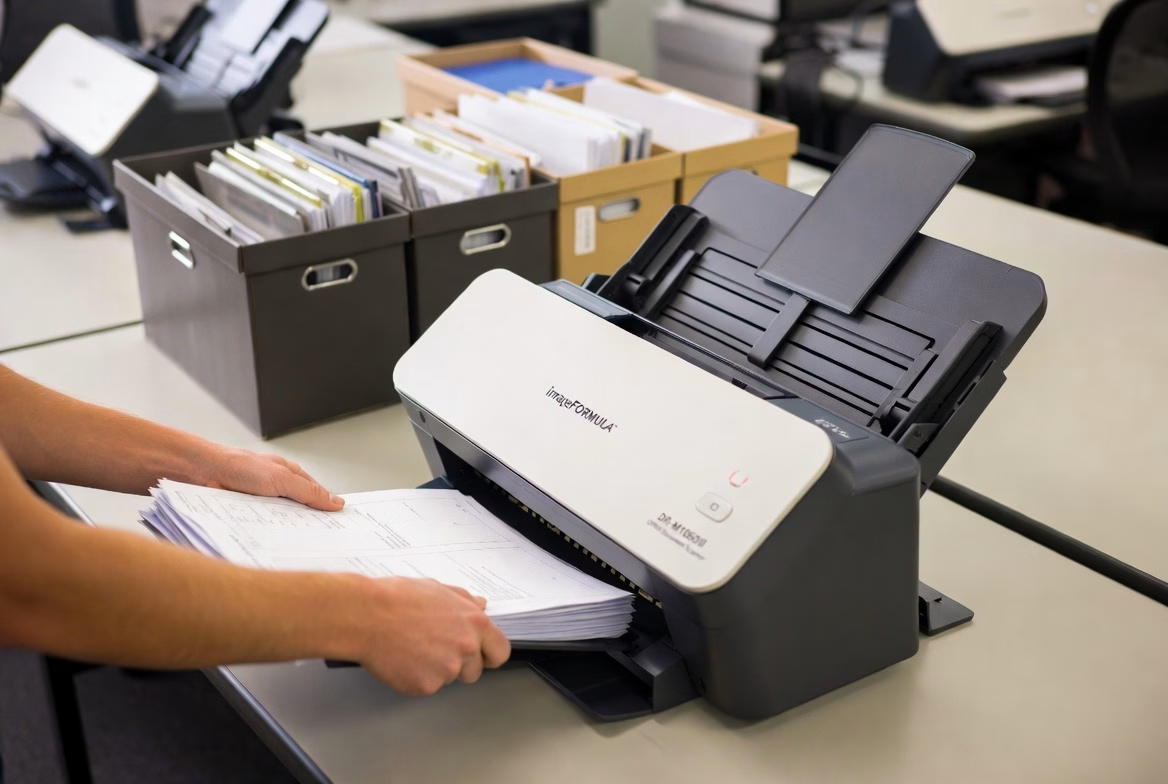
One of the first questions every business asks about scanning is “how much does it cost per page?” It is a reasonable question, but the honest answer is that per-page pricing only tells part of the story. The total cost of a scanning project depends on what you are scanning, how much preparation is needed, what level of indexing you require, and whether compliance protocols apply.
This guide breaks down the factors that determine scanning costs so you can evaluate quotes accurately and understand what you are paying for. For legal productions specifically, see what goes into a discovery load file and why it changes the deliverable.
Typical Per-Page Pricing Ranges
Industry-wide, standard document scanning for letter-size pages typically falls between $0.07 and $0.15 per page. That range is wide because the actual price depends heavily on the factors below. Here is how those ranges generally break down by project type.
Standard office documents (clean, uniform pages, minimal prep): $0.07 to $0.10 per page. This is the baseline for well-organized records in good condition — think neatly filed correspondence, typed reports, or pre-sorted records.
Medical and legal records (mixed formats, compliance requirements): $0.08 to $0.14 per page. Healthcare and legal documents often include a mix of letter-size pages, smaller forms, sticky notes, and multi-part documents that require additional handling. HIPAA or chain-of-custody protocols add security steps that factor into pricing.
Large format documents (blueprints, engineering drawings, maps): $1.00 to $5.00+ per sheet. Oversized documents require specialized wide-format scanners and more careful handling. Pricing depends on the size of the original (24″ x 36″ versus 36″ x 48″, for example) and condition.
Bulk or backfile projects (high volume, 50,000+ pages): Volume discounts typically bring per-page costs to the lower end of each range. The more pages in a project, the lower the per-page rate, because setup and transport costs are spread across more output.
Per-Box Pricing and Turnaround Times for Phoenix Projects
Most Phoenix businesses think in boxes, not pages. A standard banker’s box holds roughly 2,500 letter-size pages, so here is how per-page rates translate to real-world project estimates.
Standard office records (pre-sorted, staple-removed, good condition): $175 to $275 per banker’s box. Mixed or prep-intensive boxes (fasteners, sticky notes, folded pages, varied sizes): $300 to $450 per box. Medical and legal records (HIPAA protocols, chain-of-custody, compliance delivery): $350 to $550 per box.
Turnaround on most Phoenix projects runs 5 to 7 business days from pickup to delivery of searchable PDFs. Rush turnaround (2 to 3 business days) is available for projects under 20 boxes. Same-day scanning is available for urgent small batches — call 602-224-9971 to confirm capacity.
Pickup is included for Phoenix metro projects. No shipping estimates, no carrier guesswork — we collect at your location and deliver finished files directly to your inbox or shared drive.
Per Page vs. Per Box vs. Per File: Which Is Cheapest for 10,000 Pages?
Scanning companies quote in three different units, and the three are not directly comparable. A per-page rate, a per-box rate, and a per-file rate can describe the same project at very different prices — and the vendor quoting the lowest-sounding number is often the most expensive one. Here is how to convert all three into the same unit and compare them honestly.
Start by converting every quote to cost per page
Cost per page is the only unit all three models share. Two pieces of arithmetic get you there:
- Per box to per page: box rate divided by the number of pages actually in the box.
- Per file to per page: file rate divided by your average pages per file.
Both conversions depend on a number the quote does not contain, which is exactly why per-box and per-file quotes are hard to shop. A standard banker’s box holds roughly 2,500 letter-size pages when it is genuinely full — but most boxes in a Phoenix storage room are not full. A $275 box quote is $0.11 per page at 2,500 pages and $0.23 per page at 1,200 pages. Same quote, double the money.
Per-file pricing behaves the same way. A $4.00 per-file rate works out to $0.10 per page across 40-page charts, and $0.16 per page across 25-page charts — 60% more for identical work. Before accepting a per-file quote, count the pages in ten representative files and divide.
What 10,000 pages looks like in each model
At 2,500 pages per box, 10,000 pages is four standard banker’s boxes. Using the ranges above:
- Per page, standard office records: $0.07 to $0.10 — $700 to $1,000
- Per page, medical or legal records: $0.08 to $0.14 — $800 to $1,400
- Per box, standard office records: $175 to $275 per box, four boxes — $700 to $1,100
- Per box, medical or legal records: $350 to $550 per box, four boxes — $1,400 to $2,200
- Per file: your file rate divided by your average pages per file, multiplied by 10,000
Notice that per-page and per-box land in nearly the same place. They should — a per-box rate is a per-page rate multiplied by an assumed box. The models are not really competing on price. They are competing on who absorbs the risk of the assumption being wrong.
So which one is actually cheapest?
For a 10,000-page project, the cheapest model is whichever one is genuinely all-in — and that is usually not the one with the lowest headline number.
Per-page quotes tend to advertise lowest and finish highest, because document preparation, indexing, OCR, oversized pages, and file delivery are commonly billed as separate line items. A $0.08 per-page quote that adds $0.03 for prep and $0.02 for indexing is a $0.13 per-page quote. Per-box pricing that includes prep, scanning, indexing, OCR, delivery and pickup usually wins at this volume, because there is nothing left to add. Per-file pricing is rarely the cheapest route for bulk digitization at all — it is priced for retrieval-style release-of-information work, where someone pulls one chart at a time, not for scanning a records room.
The question that settles it in one sentence, and the one worth asking every vendor you are considering: “What is your all-in cost per page for my actual boxes, including prep, indexing, OCR and delivery, with nothing billed separately afterward?” A company that can answer that with a number is quoting you a price. A company that cannot is quoting you a rate.
Overland Printing quotes Phoenix projects all-in, with pickup included and no per-item surprises after the fact. Call 602-224-9971 for a same-day estimate on your boxes.
Is per-page or per-box scanning cheaper?
Neither is inherently cheaper — a per-box rate is a per-page rate times an assumed number of pages per box. Per-box is cheaper in practice when the boxes are full and the rate is all-in; per-page is cheaper when your boxes are half-empty and preparation is genuinely included. Convert both to cost per page before deciding.
What does it cost to scan 10,000 pages?
Roughly $700 to $1,000 for standard office records and $800 to $1,400 for medical or legal records, based on typical per-page ranges. Prep-intensive material, oversized pages, and detailed indexing move the figure upward, so confirm what is included before comparing two quotes.
What Factors Affect Your Scanning Cost?
Document Preparation
This is where many projects see costs they did not expect. “Document prep” means removing staples, paper clips, binder clips, and rubber bands; unfolding creased or tri-folded pages; repairing torn pages with tape; separating pages that are stuck together; and removing sticky notes or re-attaching them so they scan properly.
If your records are neatly filed and staple-free, prep is minimal. If they have been sitting in boxes for a decade with mixed fasteners and dog-eared pages, prep time adds up. Some vendors charge prep separately; others build it into the per-page price.
Indexing and Organization
Basic scanning means you get a folder of image files. Indexing means those files are named, organized, and tagged so you can actually find things later. The level of indexing you need directly affects cost.
Basic indexing (file-level naming): Each document or folder is named according to a simple convention — patient name, case number, or date. This is the most common approach and adds minimal cost.
Detailed indexing (field-level metadata): Each document is tagged with multiple searchable fields — patient name plus date of service plus document type, for example. This is more labor-intensive but makes retrieval significantly faster for large archives.
Barcode or separator sheet processing: For high-volume projects, barcode separator sheets can automate document splitting and indexing, reducing manual labor and per-page cost on large batches.
OCR (Optical Character Recognition)
OCR converts scanned images into searchable text, so you can search inside a document rather than just by its file name. Most modern scanning projects include OCR as a standard feature, but for handwritten documents or poor-quality originals, advanced OCR processing may add $0.01 to $0.03 per page.
Compliance and Security Requirements
Healthcare, legal, and financial records require additional security protocols: Business Associate Agreements, chain of custody documentation, encrypted file delivery, and certificate of destruction for originals. These safeguards are necessary and worth the cost, but they do add to the total.
Output Format and Delivery
Most projects deliver searchable PDF files, which is the standard for business document archives. If you need additional formats (TIFF for legal archiving, specific naming conventions for your document management system, or integration with cloud storage), customization may affect pricing.
The Hidden Cost of Not Scanning
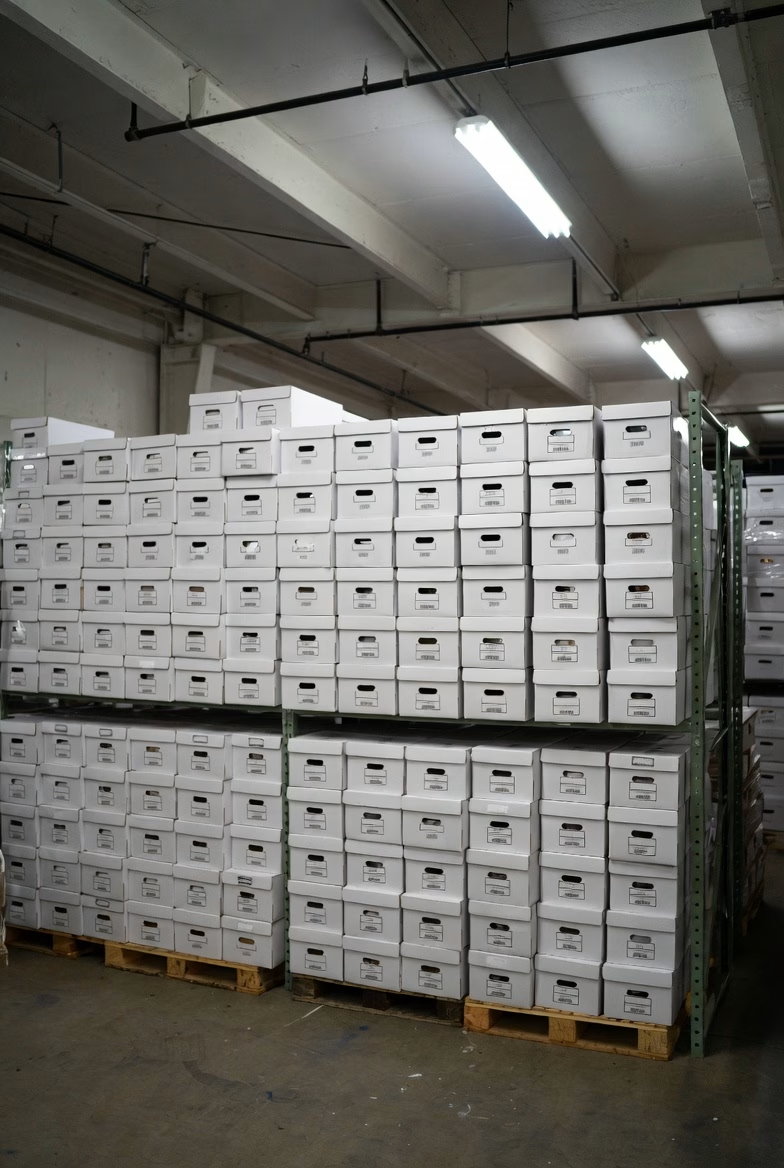
Before focusing solely on per-page price, consider what paper records cost you right now. Office space in Phoenix averages $25 to $35 per square foot per year. A four-drawer filing cabinet occupies about 8 square feet when you account for the aisle space needed to open drawers. That is $200 to $280 per year just for the floor space, not counting the cabinet itself.
Then there is retrieval time. Studies consistently show that office workers spend an average of 20 to 30 minutes per day searching for paper documents. Over a year, that adds up to over 100 hours per employee — time that could be spent on actual work.
And storage only grows. Every year adds more paper. Scanning stops the accumulation and can eliminate existing storage costs entirely once the backfile is digitized.
Estimate Your Project Cost by the Box
Most businesses think in boxes, not pages. A standard banker’s box holds approximately 2,500 pages. Here is what a typical project looks like in real dollars:
| Project size | Approximate pages | Estimated cost range |
|---|---|---|
| 5 boxes | ~12,500 pages | $875 – $1,875 |
| 10 boxes | ~25,000 pages | $1,750 – $3,750 |
| 25 boxes | ~62,500 pages | $4,375 – $9,375 |
| 50 boxes | ~125,000 pages | $8,750 – $18,750 |
Volume projects (50+ boxes) typically land at the lower end of the per-page range. HIPAA-required compliance protocols — BAA, chain of custody, encrypted delivery — are included in the estimate at no line-item surprise.
Call 602-224-9971 or use the form below to get a quote specific to your document count and condition.
How to Get an Accurate Quote
The most reliable way to understand your scanning costs is to get a project-specific estimate. A good scanning vendor will ask you about the approximate number of pages or boxes (a standard banker’s box holds roughly 2,500 pages), the condition and format of your documents, what level of indexing you need, whether compliance protocols apply, and your preferred output format and delivery method.
At Overland Printing, we provide free, no-obligation estimates for every scanning project. We will assess your documents, recommend the right approach, and give you a clear price before any work begins. No surprises.
Why Your Quote Should Come From One Company, Not Five
If you have requested a document scanning quote online before, you may already know what happens next: you fill out one form, and your phone starts ringing from three or four scanning companies you have never heard of. That happens because several of the sites that rank for “document scanning Phoenix” are not scanning companies at all — they are lead-generation services that collect your project details and resell them to a network of local vendors who then compete to reach you first.
Nothing submitted on this page goes anywhere but Overland. Call 602-224-9971 or use the form below and you are talking directly to the company that will scan your documents — not a broker deciding which vendor gets your contact information next. One quote, one point of contact, from the people actually doing the work.
Want to know what your project will cost? Get a free scanning estimate or call us at 602-224-9971.
Related reading: The 4 Best Large Format Scanners for 2025 — a side-by-side review of the Contex flatbed and production scanners we use to deliver these projects.
A practice or office closure is one of the most common reasons a scanning budget appears at all. If that is why you are pricing this out, read what Arizona requires of a closing medical practice first — the retention obligation, not the box count, usually decides the real scope of the job.
Industry-Specific Scanning Services
- Medical records scanning — HIPAA-compliant, BAA signed before pickup, EHR-ready indexing
- Legal and litigation scanning — Bates numbering, Relativity-ready load files, ER 1.6 confidentiality protocols
- AEC project record scanning — drawings + specs + submittals + RFIs, indexed by project
- General document scanning — contracts, financials, business archives
For HOA management firms specifically, our HOA records scanning service for community association management firms covers the per-box and per-community pricing models management firms typically work with — locked transport, AZ retention indexing, and DMS-ready delivery for ProCon, AppFolio, HOA Manager, Caliber, FirstService, and similar systems.
For law firms specifically, our litigation support pricing covers per-project flat-fee, trial-week retainer, and per-binder unit pricing models — in addition to the discovery-side scanning pricing on this page.
For questions about project changes or cancellations after scanning begins, see our return and revision policy. Ready to get started? Call 602-224-9971.