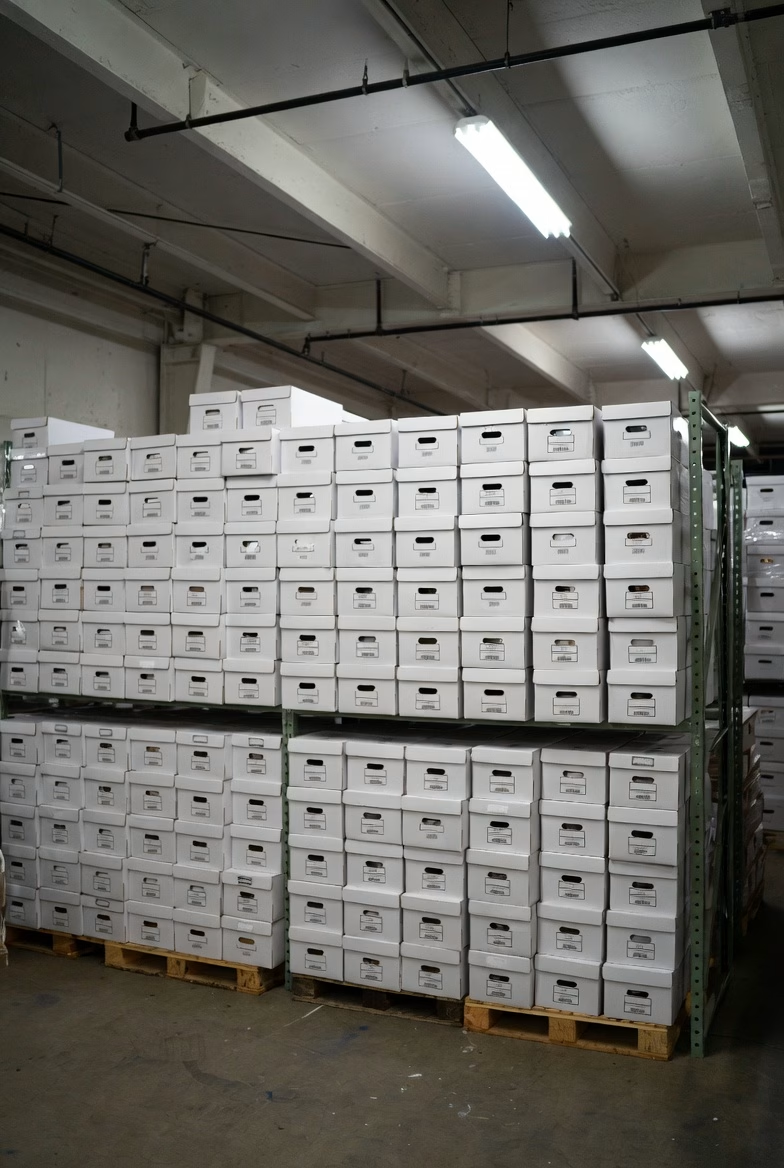
If you manage a homeowners association in Arizona, your filing cabinets probably tell a story you would rather not think about — decades of meeting minutes, financial statements, architectural review files, violation letters, and governing documents stacked in boxes that nobody wants to organize but nobody dares throw away.
That instinct to hold on to everything is not entirely wrong. Arizona law imposes specific retention requirements on community associations, and some records must be kept permanently. The challenge is knowing which documents fall into which category and making sure they are actually accessible when a homeowner, auditor, or attorney comes looking.
What Arizona Law Requires
HOA records retention in Arizona is governed by two main statutes: ARS 33-1805 (for planned communities) and ARS 10-11601 (which applies to HOAs incorporated as nonprofit corporations, as most are).
Together, these statutes create three tiers of retention requirements.
Records You Must Keep Forever
Certain foundational documents must be retained permanently. These include the CC&Rs (declaration of covenants, conditions, and restrictions), articles of incorporation, bylaws, all amendments to governing documents, deeds, easements, and board resolutions relating to member rights and obligations.
Meeting minutes — both board and member meetings — are also considered permanent records under ARS 10-11601. There is no point at which it becomes safe to discard them.
Records You Must Keep for Seven Years
Financial records fall into this category. While ARS 10-11601 requires financial statements to be available for at least the past three years, the widely accepted best practice for community associations is seven years. This aligns with IRS audit timelines and ensures the association has a complete financial history for budgeting, reserve studies, and potential litigation.
Financial records include annual budgets, bank statements, tax returns, reserve fund reports, vendor invoices, assessment records, collection activity, and insurance policies.
Records You Must Keep for at Least Three Years
Written communications to members generally, notices of meetings, and records of actions taken without a meeting must be maintained for at least three years under ARS 10-11601.
Architectural review applications, violation notices, and routine correspondence typically fall into this category as well, though many associations choose to retain these longer for liability protection.
Homeowner Access Rights: The 10-Day Rule
Arizona law gives homeowners significant access to association records. Under ARS 33-1805, an HOA must make financial and other records “reasonably available for examination” by any member. When a homeowner submits a written records request, the board has ten business days to provide access.
The association may charge up to fifteen cents per page for copies. However, certain records are exempt from disclosure, including privileged attorney-client communications, executive session minutes, and individual member or employee records.
This access requirement is one of the strongest reasons to keep records organized and retrievable. A board that cannot locate requested documents within the ten-day window risks legal complaints and loss of homeowner trust.
Why Paper Records Become a Liability
Most Arizona HOAs accumulate paper records over years or decades of operation. Over time, these records create several problems that go beyond simple clutter.
Retrieval delays. When a homeowner submits a records request, staff or board volunteers must physically search through files to locate the relevant documents. For associations with records spread across multiple boxes, storage units, or management company offices, meeting the ten-day deadline becomes a real challenge.
Transition risks. When an HOA changes management companies — a common occurrence — physical records must be transferred. Documents get lost, misfiled, or damaged during transitions. Some associations discover gaps in their records only when a dispute arises and the relevant paperwork cannot be found.
Disaster vulnerability. Arizona may not face hurricanes, but fire, flooding from burst pipes, and monsoon water damage are real threats to paper archives. Governing documents that must be kept permanently are irreplaceable if destroyed.
Storage costs. A mid-size HOA managing 200-500 homes can easily accumulate dozens of boxes of records over a ten-year period. Offsite storage rental, retrieval fees, and the staff time required to manage physical files add up quietly but consistently.
How Scanning Solves These Problems

Digitizing HOA records addresses every challenge above while making compliance with Arizona’s retention and access requirements significantly easier.
Instant retrieval. Scanned records stored as searchable PDFs can be located in seconds using keyword search. When a homeowner submits a records request, the response can be prepared in minutes rather than days.
Management transitions. Digital archives transfer seamlessly between management companies. There are no boxes to ship, no pages to inventory, and no risk of documents disappearing during the handoff.
Permanent preservation. Documents that Arizona law requires you to keep forever — CC&Rs, bylaws, meeting minutes — are protected from physical damage when stored digitally with proper backups. The digital copy will be as legible in fifty years as it is today.
Reduced costs. Scanning eliminates the ongoing expense of physical storage and dramatically reduces the staff time devoted to filing and retrieval. For associations paying monthly storage fees, the scanning project often pays for itself within a year.
Board and homeowner confidence. A well-organized digital archive signals professionalism. Board members can access any document from any location, and homeowner requests are handled quickly and completely.
Getting Started: What to Scan First
If your association is considering digitizing its records, the most practical approach is to prioritize by retention requirement.
Start with permanent records. CC&Rs, bylaws, articles of incorporation, all amendments, board resolutions, and meeting minutes. These are irreplaceable and carry the highest risk if lost.
Then financial records. Current and recent fiscal year documents first, working backward through the seven-year window. This ensures your most frequently requested records are available digitally as soon as possible.
Finally, correspondence and administrative files. Violation records, architectural applications, vendor contracts, and general communications. These have shorter retention requirements but are often the most frequently requested.
Protect Your Community’s Records
Arizona’s HOA records requirements are not optional, and the consequences of poor recordkeeping — from homeowner complaints to legal exposure — are real. Scanning your association’s documents is one of the most cost-effective ways to stay compliant, organized, and prepared for whatever comes next.
Overland Printing has served Phoenix-area organizations for over 25 years. We handle high-volume document scanning with secure chain of custody, searchable PDF delivery, and organized indexing — so your board can find any document in seconds, not hours.
Ready to get your HOA records under control? Get a free scanning quote or call us at 602-224-9971.
This article is provided for general informational purposes and does not constitute legal advice. HOA boards should consult with a qualified community association attorney regarding their specific retention obligations.